
No Tate County 72-Hour Feed
There is no official Tate County 72-hour release feed. The sheriff publishes a searchable current roster, but it has no rolling three-day view, released archive, release date, or release type. The official website, navigation, OCV manifest, live feed, and app configuration were reviewed on July 26, 2026. Plausible release-feed keys also produced no documented feature. An empty undocumented endpoint cannot be presented as a county record.
The public interface is built around bookings. It shows who is listed now and sorts by booking date. A booking from three days ago is not proof of a release within that period. Likewise, removal from the feed may reflect community release, transfer to MDOC, movement to another county, federal pickup, medical movement, a correction, or a data interruption. Tate County release research must identify the actual event.
Build Tate County's Three-Day Window
Choose a clear start and end time before contacting the jail. A request for all release entries from a named date and time through another date and time is more precise than “the last few days.” Record the search time as well. A rolling 72-hour period changes by the minute, while a calendar-based period stays fixed. If the goal is to cover a weekend, state the full dates rather than assuming the jail applies a Monday look-back rule.
- Search the current roster for each known name and preserve booking dates, charges, and identifying fields.
- Call Tate County Jail at 662-562-5466 and ask whether each named episode ended in release, transfer, or correction.
- Request jail docket or release entries for the fixed three-day span, including release date, time, authority, and destination.
- Match each event to the signed order in the court that handled the bond, charge, sentence, or dismissal.
- Follow a documented transfer through MDOC, the receiving jail, BOP, ICE, or the federal docket as appropriate.
The jail address is 1 Justice Drive, Senatobia, MS 38668. Published office hours are 8:00 a.m. to 5:00 p.m. CST, Monday through Friday. Those hours do not describe when releases occur. No official Tate source states public release-counter hours, a weekend schedule, or a holiday processing rule.
Readers focused only on the current day can use the Tate County 24-hour release check, which applies a narrower verification period.
Tate County 72-Hour Record Fields
A complete three-day result must contain release fields, not just booking details. Tate's current roster provides several useful identity clues. The omitted fields are exactly why the jail record and court order are needed.
| Field | Shown on current roster? | Why it matters |
|---|---|---|
| Name and basic description | Yes | Helps match the custody episode |
| Booking date and time | Yes | Sets the start, not the end, of custody |
| Charge and bond fields | Yes | Point to the case and possible authority |
| Release date and time | No | Places the event inside or outside the 72-hour period |
| Release authority or type | No | Distinguishes bond, dismissal, time served, sentence end, and other outcomes |
| Destination or transfer agency | No | Separates community release from continued custody elsewhere |
| Booking number | No | Can distinguish people and repeat bookings when supplied by the agency |
Ask the sheriff for the jail docket, booking record, and release entry tied to the period. The request should identify each person and approximate booking date when known. Seek electronic copies, any nonexempt portions after redaction, and a written cost estimate. Tate County's official FAQ links a general Public Information Request Form, but Tate publishes no dedicated jail-record form, local fee schedule, or guaranteed turnaround.
Note: A signed order explains the legal basis, while the jail entry records the actual physical release or transfer event.
Tate County Weekend Release Checks
A wider period is most useful for continuity, not because Tate publishes a weekend list. Court orders, bond processing, jail operations, and public-office availability do not share one clock. An event may occur while the office that supplies a copy is closed. Another hold can also delay physical exit after a court acts. For that reason, the order date and the jail release time should be recorded separately.
Begin the period before the expected event and end it after the full interval being checked. If Monday access follows a weekend, ask the jail for each release or transfer event in the fixed range. Do not infer that every person absent on Monday left during the weekend. Some names may have been removed earlier, corrected, or moved into another custody system. A roster update cadence is not published, so apparent timing from the web page is not reliable.
The Tate Circuit Clerk handles Circuit and County Court records at the Tate County Courthouse. The county's official courts page explains the local divisions. Justice Court handles misdemeanor criminal cases, county traffic matters, preliminary felony hearings, warrants, and bond setting. Municipal matters can remain in municipal court. Use the court shown on the booking, citation, or bond paper. A “closed” docket label is weaker than the decisive signed order.
Why Tate County Release Clues Mislead
Tate's OCV schema contains name, age, race, sex, booking date and time, charge text, bond type, bond amount, and often a booking image. It does not contain release time, reason, destination, court disposition, sentence end, or a status label. The official manifest lists other sheriff features but no released-feed module. This is a documented access gap, not proof that no underlying release record exists.
The official current-roster image below shows the page used for current custody and the absence of a released tab.
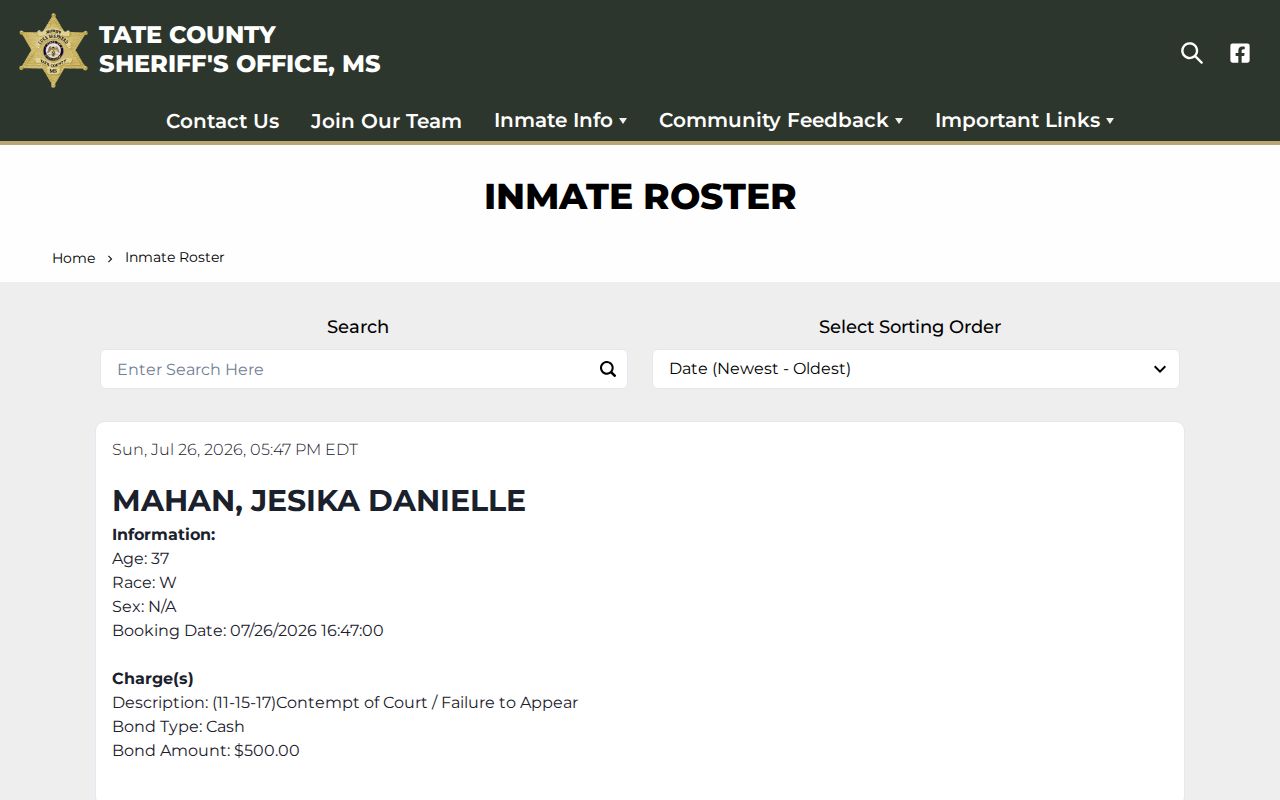
The screenshot helps identify the correct official source. It cannot establish that anyone was released. Preserve relevant identifiers, then obtain the discharge or transfer entry from the jail.
- Community release
- The county hold ended and the person left for the community, possibly under court or supervision conditions.
- Transfer
- Another agency took custody, so incarceration or detention continued.
- Parole
- Prison confinement ended conditionally while the sentence and supervision continued.
- Maximum discharge
- The state records the sentence endpoint without early-release allowances.
Tate County Release Records Persist
Mississippi's county retention schedule makes a key distinction. A public roster entry may vanish with no archive, yet the jail docket is permanent. Booking records are kept for ten years after release. Inmate case files are kept for 25 years after release. Individual transport records have a ten-year period after release, and some jail census records include incarceration and release times.
For an older three-day period, name the record series. Ask for the permanent jail docket entry, the booking record, and the release or discharge record for the fixed dates. If transfer is suspected, request the destination agency or transport entry. This focused wording is better than asking whether old website pages exist. Records tied to litigation or investigation may be held beyond ordinary schedules.
The Mississippi Ethics Commission public-records guidance explains request procedure, actual-cost fees, redaction, and written denials. A public body should produce reasonably segregable nonexempt material. When withholding occurs, ask for the specific legal basis. Mississippi Ethics Commission Order R-20-012 treated another sheriff's jail docket as a public record, though each Tate request depends on its facts and applicable exemptions.
Route Tate County Three-Day Releases
The next search depends on the destination shown in the Tate record. A person sent to the Mississippi Department of Corrections remains in state custody. Search the MDOC Inmate Search by name or MDOC ID. A later Parolees Search match supports release into community supervision, but not maximum discharge. Request a discharge certificate or state release record for the end of state custody.
Mississippi SAVIN/VINE is a future-alert channel for MDOC and participating county jails. Its events may include release, transfer, temporary movement, return to custody, escape, or abscond supervision. Confirm Tate in the current VINELink selector. Read the event type carefully. A transfer notice explains a roster disappearance without proving a community release.
Federal and immigration routes require a real custody link. A federal docket and the BOP locator apply after federal involvement is established. “Not in BOP custody” ends only the BOP episode. An ICE transfer calls for the Online Detainee Locator and immigration case record. USMS has no comparable public name locator for pretrial and transport custody. The Tate jail record is the bridge into each system.
| Evidence | Weight | Next check |
|---|---|---|
| Jail release entry plus court authority | Strong | Confirm identity and destination |
| Matched VINE release alert plus jail confirmation | Strong | Preserve the event time and source agency |
| MDOC parolee result | Community supervision | Check Tate supervision office or MDOC record |
| Roster disappearance or bond amount | Lead only | Call jail and obtain the release record |
For one named person whose path is unclear, use the broader Tate County released inmate search to compare county, court, state, and federal records.