
Tate Parole and Probation Differences
Parole, probation, and earned release supervision describe different legal positions. Parole is a discretionary, conditional release from incarceration granted by the Mississippi State Parole Board. The prison term continues while the person lives in the community under stated conditions. Probation is ordered by a court. It can follow a suspended sentence or begin without a state-prison release at all. Earned release supervision, often called ERS, is an MDOC placement under which the person remains an inmate and stays within MDOC jurisdiction until the sentence expires.
That distinction controls the correct Tate County lookup. A former state prisoner may appear in the MDOC Parolees Search. A probationer may instead be confirmed through the sentencing case and the local MDOC community corrections office. Someone in ERS may have a community placement while still retaining inmate status. The words should not be treated as interchangeable, because each has a different authority, record, and endpoint.
| Status | Who authorizes it | What it means | Best verification route |
|---|---|---|---|
| Parole | Mississippi State Parole Board | Conditional release from prison while the sentence and supervision continue | MDOC Parolees Search, then the Tate office |
| Probation | Sentencing court | Court-ordered community supervision, sometimes without a prison release | Court order and MDOC community corrections |
| ERS | MDOC under state law and rules | Conditional early placement with inmate status retained | MDOC inmate record, case manager, and supervision office |
| Maximum discharge | Sentence computation and official discharge | The state custody term reaches its endpoint | MDOC discharge record or certificate |
- Absconder
- A supervised person whom the agency reports as having stopped required contact or whose location is unknown.
- Discharge
- The documented end of the relevant sentence or supervision term.
- Flat-time date
- A date displayed in the parolee record that must be read with the current supervision status.
Verify Tate County Post-Release Supervision
Begin with identity, not the status label. The MDOC home page provides separate Inmate Search and Parolees Search entry points. Search exact and alternate name forms, and use an MDOC number when known. A parolee template may display the MDOC ID, county, supervising officer, flat-time date, race, sex, birth date, and photo. Compare enough fields to avoid joining the record of one person to another with the same name.
The two searches answer different questions. An inmate result with a current prison location points to state incarceration. A matching parolee result supports release into community supervision, but does not prove maximum discharge. No parolee hit does not settle the matter either. The person could be on probation or ERS, fully discharged, returned to custody, missing because of spelling or update issues, or under a different custody system.
- Open MDOC and run Inmate Search using the full name or MDOC ID. Record the location and location-change date.
- Run Parolees Search separately. Compare the MDOC ID, birth information, county, photograph, supervising officer, and flat-time date.
- Check the sentencing court record through the Tate County courts route when probation, a revocation, or the terms of supervision are at issue. The signed order has more weight than a short docket label.
- Contact the Tate County Probation & Parole Office when the public detail is blank, stale, or ambiguous. Ask for confirmation of the public status, not confidential case notes.
- For parole eligibility or a Board decision, contact the Mississippi State Parole Board. Eligibility is not the same as release.
For the earlier county-jail event, use the release record process on the Tate County released inmates search. Removal from the Tate County Jail roster alone does not show parole, probation, or community release.
Tate Supervision Office Verification Route
Tate County has a local MDOC Community Corrections office in Senatobia. It is not a jail and does not publish a local inmate roster. Its role makes it a direct fallback when the MDOC parolee record is dynamic, incomplete, or hard to match. A former state prisoner released on parole, a probationer, or another person under MDOC community supervision may report through this office.
The official Tate Probation & Parole Office page is the source for the office listing. The captured official page shows the location readers should verify before relying on an older directory.
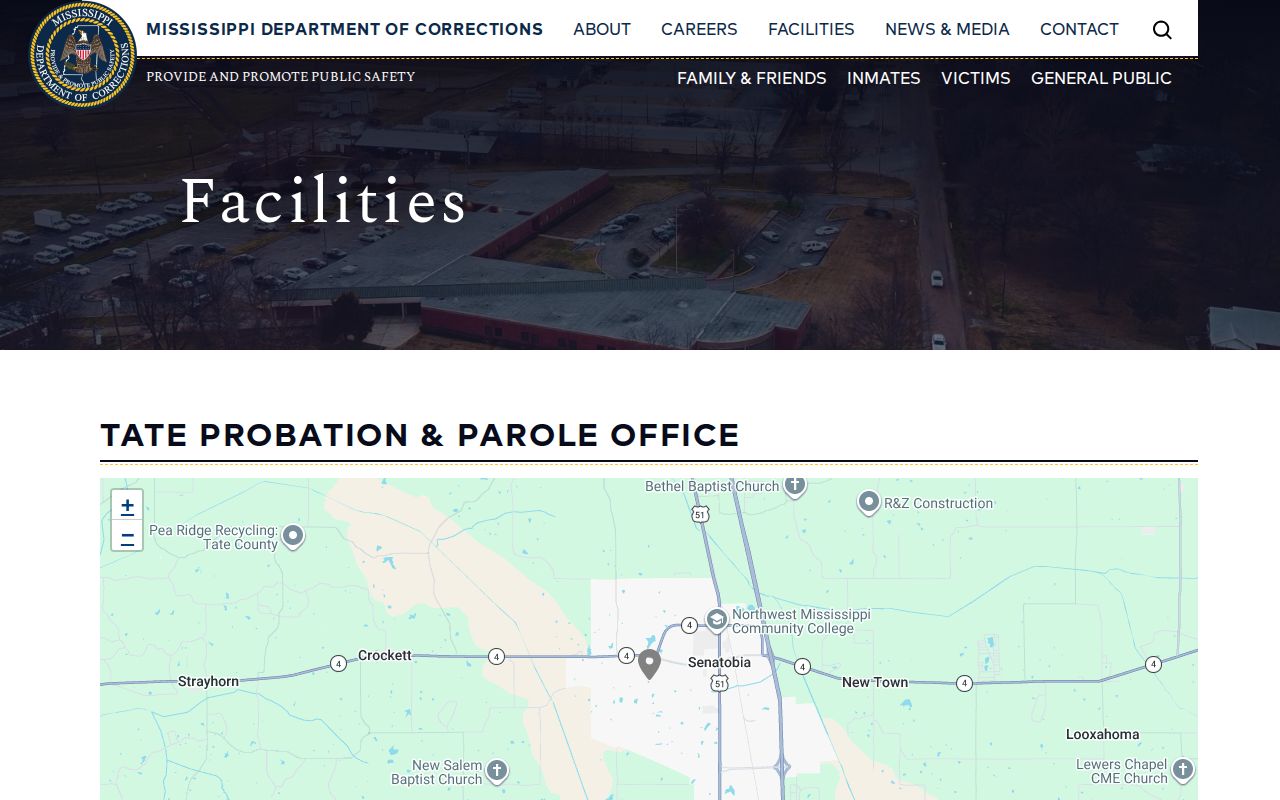
This office listing gives Tate County residents a named local route for supervision questions that the statewide public search cannot resolve on its own.
Tate County Probation & Parole Office
908 E. F. Hale Drive
Senatobia, MS 38668
Phone: 662-301-4343
Fax: 662-301-4342
MDOC identifies Tony P. Harris as Community Corrections Director. That state-level leadership fact does not identify a particular person’s field officer. Staff may also limit what they disclose. Ask whether the public record is current, which office has supervisory responsibility, and which agency can issue an official discharge record.
Note: Office confirmation can clarify a public status, but confidential supervision details may remain unavailable to a caller.
Tate Parole Board Record Limits
The Mississippi State Parole Board grants, denies, or revokes parole within its authority. MDOC field staff supervise community cases but do not replace the Board’s decision function. Mississippi Code § 47-7-3 is heavily amended, and eligibility depends on the offense, sentence, and controlling law date. Current administrative Rule 3.1 also identifies excluded groups, including habitual, sex, capital and murder offenders, certain trafficking cases, and sentences that are expressly nonparolable.
No current official person-by-person hearing calendar, monthly docket, or searchable results database was found in the Board directory or indexed state materials reviewed for Tate County. An old calendar should not fill that gap. The official Parole Board directory lists the current public contact route for eligibility and decision questions.
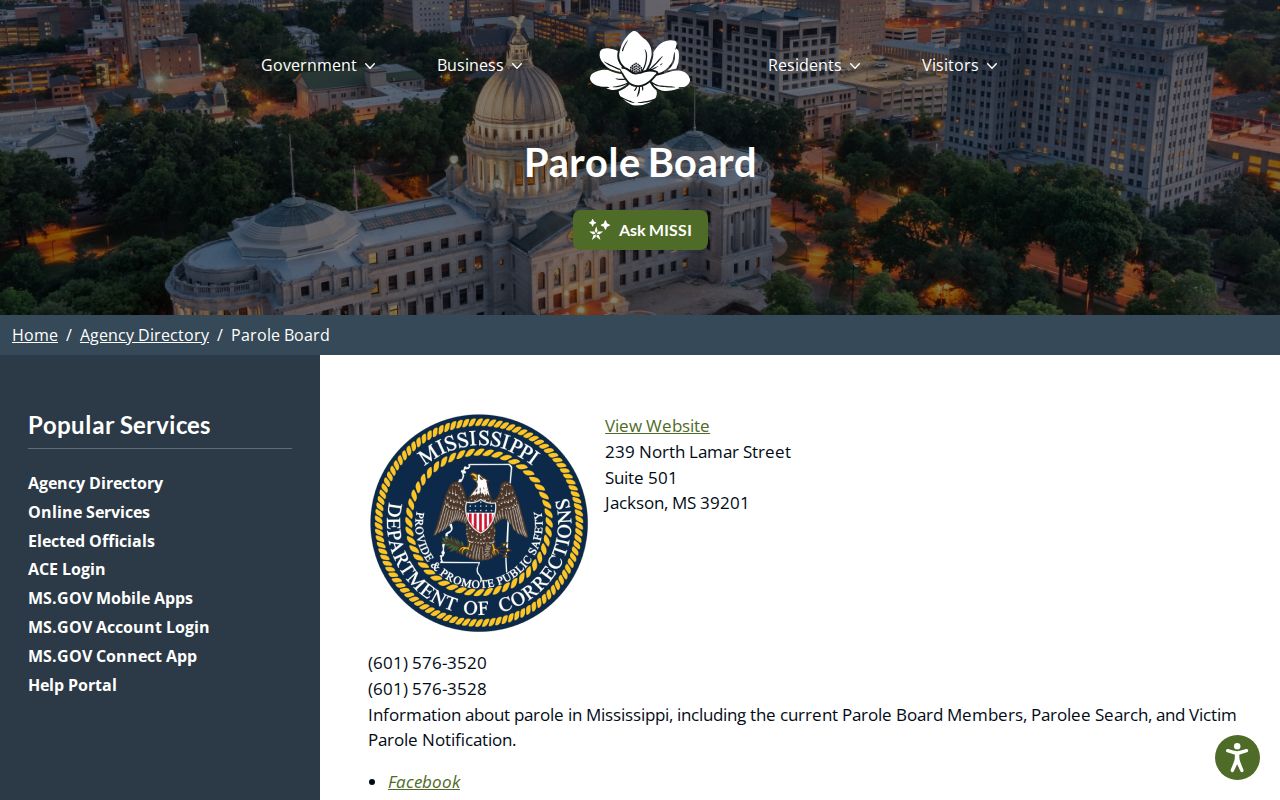
The state directory confirms the Board’s service and contact details, while a case-specific decision still requires a matched official record or direct Board response.
Mississippi State Parole Board
239 North Lamar Street, Suite 501
Jackson, MS 39201
601-576-3520 or 601-576-3528
The MDAH collection of Board minutes covers 1942 through 2009. It can support historical work, but it is not a current hearing tool. A computed eligibility date means review may be possible. It never guarantees that parole will be granted or that release processing has finished.
Tate Supervision Conditions and Violations
Conditions are the rules attached to community supervision. They may require reporting, approved residence or travel, payment or programming, and compliance with court or agency directions, but the controlling order and MDOC record govern each person. A public parolee template is not the full set of case terms. Ask the sentencing court for a probation order and the proper agency for an official parole or ERS record.
A violation allegation can lead to added reporting, a warrant, arrest, a hearing, or return to custody, depending on the status and authority involved. A “violation of probation” charge on the Tate County Jail roster is a clue about a new custody episode. It is not a complete history of the person’s earlier release. Likewise, an absconder alert means the supervision agency reports a loss of required contact. It is not the same as maximum discharge.
Mississippi SAVIN/VINE can send an abscond-supervision alert when the contributing system supports it. It can also report return to custody. Those updates are useful for timely notice, but a matched MDOC record, court order, or office response is needed to explain the legal result.
Note: A warrant or revocation question belongs with the issuing court or agency, since a roster charge alone does not show the final outcome.
Tate Release and Supervision Boundaries
The custody source matters. The official Tate County Jail roster covers current county custody, so a detainee released on bond may have an open court case but no MDOC parole record. A defendant transferred from the jail to an MDOC prison remains in custody. A later parolee hit can support physical release from state incarceration into community supervision. Maximum discharge, by contrast, requires an MDOC endpoint record rather than an inference from either search.
Federal supervised release is imposed through a federal judgment and is not Mississippi parole. ICE release or transfer is another distinct event. The Tate supervision office should not be asked to confirm those systems. Start with the agency that held or supervised the person, then match the order, identifier, and date to the same episode.
| Tate jail release | Confirm with the jail release event and the court authority. |
|---|---|
| MDOC parole | Match Parolees Search and confirm through the Tate office when needed. |
| MDOC discharge | Request the official discharge record or certificate. |
| Federal supervision | Read the federal judgment and use the federal probation route. |
Tate Supervision Discharge Records
Supervision ends through an official discharge or other documented agency or court action. A flat-time date, tentative date, or expected sentence endpoint is not by itself the discharge record. Parole can end at the proper sentence endpoint, probation can conclude under the court’s order, and ERS remains within MDOC jurisdiction until the sentence expires unless another lawful action changes the status.
Ask MDOC Constituent Services for a discharge certificate or related time record when state imprisonment is involved. Include the MDOC ID and conviction county. For probation, obtain the sentencing and discharge orders from the court that handled the case. If a later revocation changed the sentence, request that signed order as well. This keeps an expected end date separate from the documented end of legal supervision.