
Tate County Federal Custody Paths
This page combines the two federal Facility Map entries that share one destination: Federal Bureau of Prisons institutions and the ICE detention network or U.S. Marshals custody. They are not one agency. BOP confines people serving federal criminal sentences. The U.S. Marshals Service manages many federal defendants from a detention order through trial, acquittal, conviction, or delivery to BOP. ICE detention is a civil immigration process and does not represent a county criminal sentence.
No BOP institution, ICE detention center, or official Tate County ICE contract was identified in the July 26, 2026 official-source sweep. A person can still move from the Tate County Jail into one of these federal systems. A vanished county roster entry proves only that the public current-custody listing changed. The Tate release record or federal docket must supply the federal link before any BOP, USMS, or ICE conclusion is drawn.
Removal from the Tate jail roster may be a federal pickup or transfer, not release into the community.
Choose the Tate Federal System
The legal stage and receiving agency determine the correct search. Start with a Tate release or transfer notation, a federal case number, or another official document that names the system. Then follow the matching route:
| Federal path | First public source | What it can establish |
|---|---|---|
| Sentenced federal prisoner | BOP Inmate Locator and federal judgment | BOP status, listed release date, and whether BOP custody has ended. |
| Federal pretrial or transport detainee | Federal court docket and appropriate USMS district | Detention authority, case stage, and movement toward trial or BOP. |
| ICE or CBP custody | ICE Online Detainee Locator | Current ICE location or certain recent ICE releases, subject to limits. |
A state arrest does not become a BOP matter merely because a federal agency appears in a report. Likewise, an ICE transfer is not a BOP sentence. Match the person, court, agency, and custody episode before interpreting any locator result.
Build an identity bundle before searching. Keep the full legal name and spelling variants, date of birth when lawfully available, Tate booking date, arresting agency, federal case number, and any BOP register or ICE A-number. Two people with similar names can pass through different systems at the same time. The official number and docket should connect the locator result to the correct episode before a status or date is reported.
Note: The named receiving agency, not the county roster disappearance, determines which federal search applies to a Tate custody change.
BOP Release Search for Tate
The BOP Inmate Locator covers federal inmates incarcerated from 1982 to the present. A register number gives the clearest route, but the locator also accepts DCDC, FBI, or INS identifiers. A name search can be narrowed by race, age, and sex. Compare the returned name and number to the federal docket rather than relying on a name alone.
The official locator capture shows the form used to begin a Tate County federal release check.
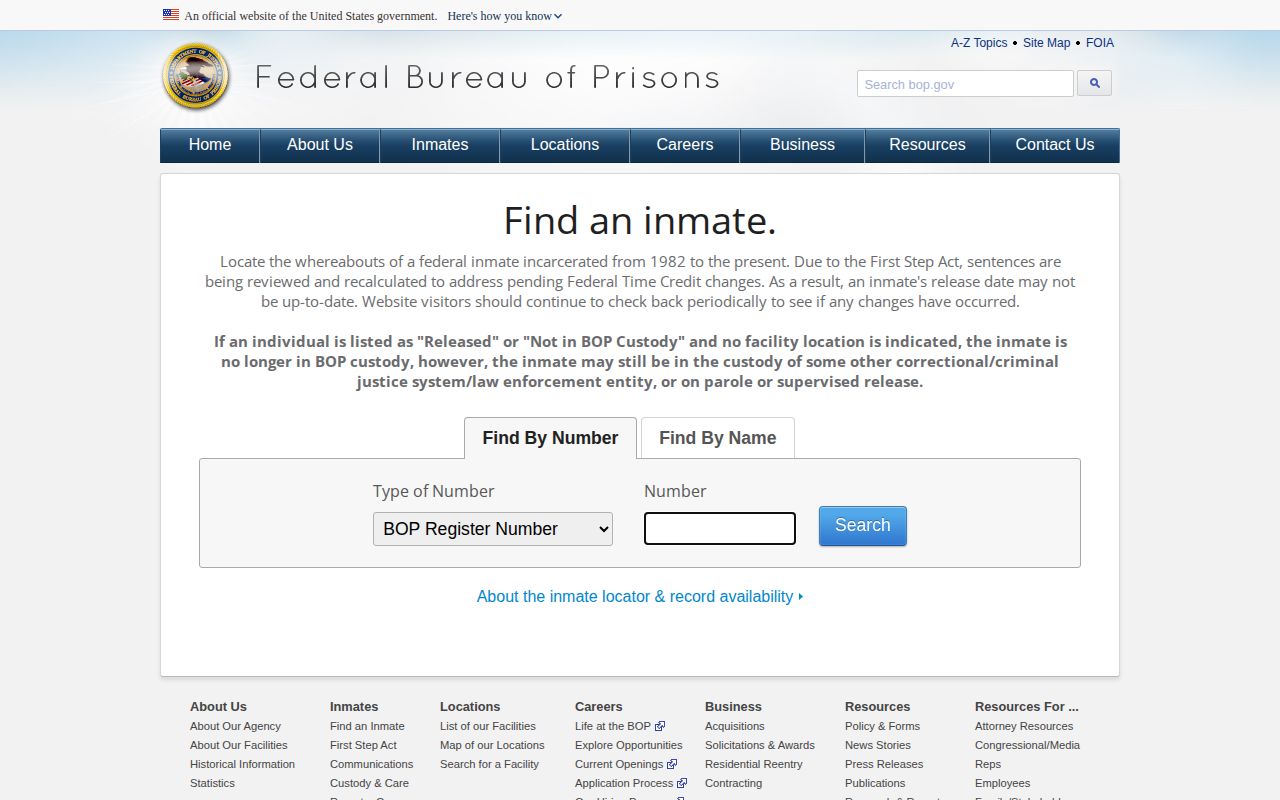
The BOP interface applies to sentenced federal custody. It does not replace the Tate sheriff record, a federal court docket, an ICE search, or a U.S. Marshals inquiry.
- Confirm that the Tate custody trail or federal case identifies a federal criminal matter.
- Search by the strongest available number, or use the full name with available identity fields.
- Compare register number, age, race, sex, listed institution or status, and release date.
- Read the federal judgment for any term of supervised release and check whether another agency took custody afterward.
Reading a Tate BOP Release
A BOP result can show a name, register number, age, race, sex, location or status, and release date. The phrases “Released” or “Not in BOP Custody” mean the person is not presently in BOP custody. They do not establish that all legal restraint ended. Federal supervised release, a state or local hold, or later ICE detention may still apply.
The BOP locator record explanation also warns that dates can change during sentence review and recalculation, including adjustments under the First Step Act. A listed future date is therefore not proof of an event that has already occurred. For a past result, pair the locator with the federal judgment and, when the custody chain is unclear, the receiving-agency record.
Evidence should be described at the right level. A matched BOP release date supports the end of the BOP confinement episode. The judgment explains whether court-ordered supervision follows. Neither source clears an unrelated Tate County case, an MDOC sentence, or immigration custody. The broader Tate County released-person search explains how to return to the county record when the federal link is uncertain.
Note: “Not in BOP Custody” addresses BOP status only and does not rule out another agency's custody or court supervision.
U.S. Marshals Custody in Tate
The U.S. Marshals Service controls many federal prisoners from a federal detention order through acquittal or conviction and eventual transfer to BOP. A person may be held in a state, local, or private facility during this stage. That means a Tate County roster removal can reflect marshal transport while confinement continues elsewhere.
USMS does not provide a broad public name locator like BOP. Its Prisoner Tracking System is an agency system, not a public search page. The agency also states that it does not release public details about federal prisoners, personal histories or photographs, or arrival and departure times. Begin with the federal court docket. Before sentencing, that docket and counsel are usually more useful than a BOP search. After a BOP sentence and intake, the BOP locator becomes the correct public tool.
U.S. Marshals Service, Northern District of MississippiU.S. Courthouse
911 Jackson Avenue, Suite 234
Oxford, MS 38655-3656
662-513-2300
Published hours: 8:30 a.m. to 5:00 p.m.
Historical agency records may be requested through the USMS Freedom of Information Act route, subject to federal privacy and law-enforcement exemptions. A public contact may still be unable to disclose a current movement or location.
ICE Release Search for Tate
The ICE Online Detainee Locator is for people currently in ICE custody or in CBP custody for more than 48 hours. ICE materials also state that it includes people released from ICE custody during the preceding 60 days. That recent visibility is useful, but it is not a permanent historical release archive.
Two search routes are available. An identifier search uses the nine-digit A-number and country of birth; add leading zeroes when needed. A biographical search uses the exact first and last name, country of birth, and an optional birth date. Hyphens and exact spelling matter. People younger than 18 do not appear in the locator. Some records may be delayed or withheld for processing, safety, security, or discretionary reasons.
A matched ICE result must be described precisely. Transfer between ICE facilities, release under conditions, removal from the United States, and release from ICE custody are distinct outcomes. None should be relabeled as a county criminal release. The Tate County discharge notation, immigration order, or direct ICE confirmation should identify what happened.
Tate ICE Release Visibility Limits
After the 60-day released-visibility period, absence from ODLS is weak historical evidence. Even during that period, a miss may reflect name formatting, an A-number issue, a short CBP period, delayed processing, or a record withheld under an agency rule. Do not declare release from a blank result.
If no record appears, the official ICE detention-information resources point users toward agency help. The Detention and Reporting Information Line is 1-888-351-4024. ICE may require a privacy waiver or Form G-28 before discussing information with someone other than the person or authorized representative. North Mississippi falls within the New Orleans field-office layer, whose published outreach address is NewOrleans.Outreach@ice.dhs.gov.
The absence of an official Tate County ICE contract in the reviewed sources does not prove that a person can never pass from local to immigration custody. It means no such local facility or contract should be claimed. Follow the documented receiving agency rather than speculating from a surname, nationality, or roster disappearance.
Note: After the 60-day ODLS visibility period, use agency or immigration-case records instead of treating a blank locator result as proof.
Trace a Tate Federal Transfer
A Tate release record can bridge the local and federal systems. Ask the Tate County Sheriff's Office whether the identified booking ended in community release or agency transfer. Request the release date and time, authority or disposition, and destination agency when public. Then use the named destination, not a guessed agency.
If the record names USMS, search the federal court case and use the Northern District contact as appropriate. If a federal sentence sends the person to BOP, search the locator after intake and allow for processing delay. If the record names ICE, use ODLS and the immigration case route. If no federal destination appears, return to the sheriff, the Tate County court directory, the Circuit Clerk, or MDOC according to the actual case. The Tate County Jail release page provides the local contact and record fields for that first step.
Keep each custody episode on its own timeline. Record the county exit, federal intake, later transfer, and federal release as separate events with separate sources. That approach prevents a later BOP or ICE result from being assigned to the wrong Tate booking or from obscuring a period of continued marshal custody between systems.
| Claim | Stronger proof | Insufficient by itself |
|---|---|---|
| BOP custody ended | Matched BOP status and release date, with docket context. | Absence from the Tate roster. |
| USMS custody changed | Federal docket order or authorized agency confirmation. | No BOP result during a pretrial stage. |
| ICE custody ended | ICE confirmation or order tied to the actual event. | ODLS absence or county roster removal. |