
Tate Supervision After Release
The Tate County Probation & Parole Office is an MDOC community-corrections office. It is not a detention facility and does not publish a jail roster. A former state prisoner may report there after parole or another supervised placement. A probationer may report there because a court imposed supervision without a prison release. The office can also be relevant when a public MDOC parolee page is incomplete, delayed, or unclear.
Community placement must not be confused with maximum discharge. Parole ends prison confinement conditionally while the sentence and supervision continue. Earned release supervision, often called ERS, is an early state placement in which the person retains inmate status and remains under MDOC jurisdiction. Probation is ordered by a court and may follow a suspended sentence. The official status and end date must come from MDOC or the court.
| Status | Who authorizes it | What the Tate office can help verify |
|---|---|---|
| Parole | Mississippi State Parole Board | Community supervision after prison release |
| Probation | Sentencing court | Local reporting status tied to the judgment |
| ERS | MDOC framework | Conditional placement while MDOC jurisdiction continues |
| Maximum discharge | Sentence and official time computation | Requires an MDOC discharge record, not just office assignment |
Verify Tate Release Supervision
Use the separate Parolees Search from the MDOC search entry points. Search by exact name or MDOC number and compare the available identity details before relying on a match. The public template may show MDOC ID, race, sex, birth date, county, supervising officer, flat-time date, and a photograph. Dynamic fields can be blank, so absence of one field should not be turned into a status claim.
A matching Tate County parolee result supports physical release into community supervision. It does not say that every sentence term has been completed. An absent parolee result is also inconclusive. The person may be on probation, in ERS, discharged, indexed under another spelling, delayed in the system, or returned to custody. Run the inmate search separately because a current prison location shows that state confinement continues.
- Search MDOC Parolees Search by MDOC ID when available, then by exact and variant names.
- Match the person through county, birth details, conviction information, and photo rather than name alone.
- Run MDOC Inmate Search to rule out a current prison location or recent state movement.
- Compare the status with the judgment, parole order, or release record for the same case.
- Call the Tate office when the public result is blank, stale, or ambiguous, while respecting disclosure limits.
A Tate supervision hit supports community placement. It does not establish that MDOC jurisdiction or the underlying sentence has ended.
Tate Release Supervision Office
The official MDOC facility page supplies a direct local route for Tate County supervision questions. Staff may confirm public routing or explain how to correct an MDOC record, but they may not disclose confidential case details to every caller. Provide the MDOC number and enough identity information to avoid a false match. Do not ask field staff to reinterpret a sentence or predict a legal outcome.
Tate County Probation & Parole Office908 E. F. Hale Drive
Senatobia, MS 38668
Phone: 662-301-4343
Fax: 662-301-4342
Agency: MDOC Community Corrections
MDOC identifies Tony P. Harris as Community Corrections Director. The source does not publish a public release counter or establish that the director personally supervises a named case. The office address is a reporting and verification route, not the place to look for someone still detained at Tate County Jail.
The official Tate office listing is shown below.
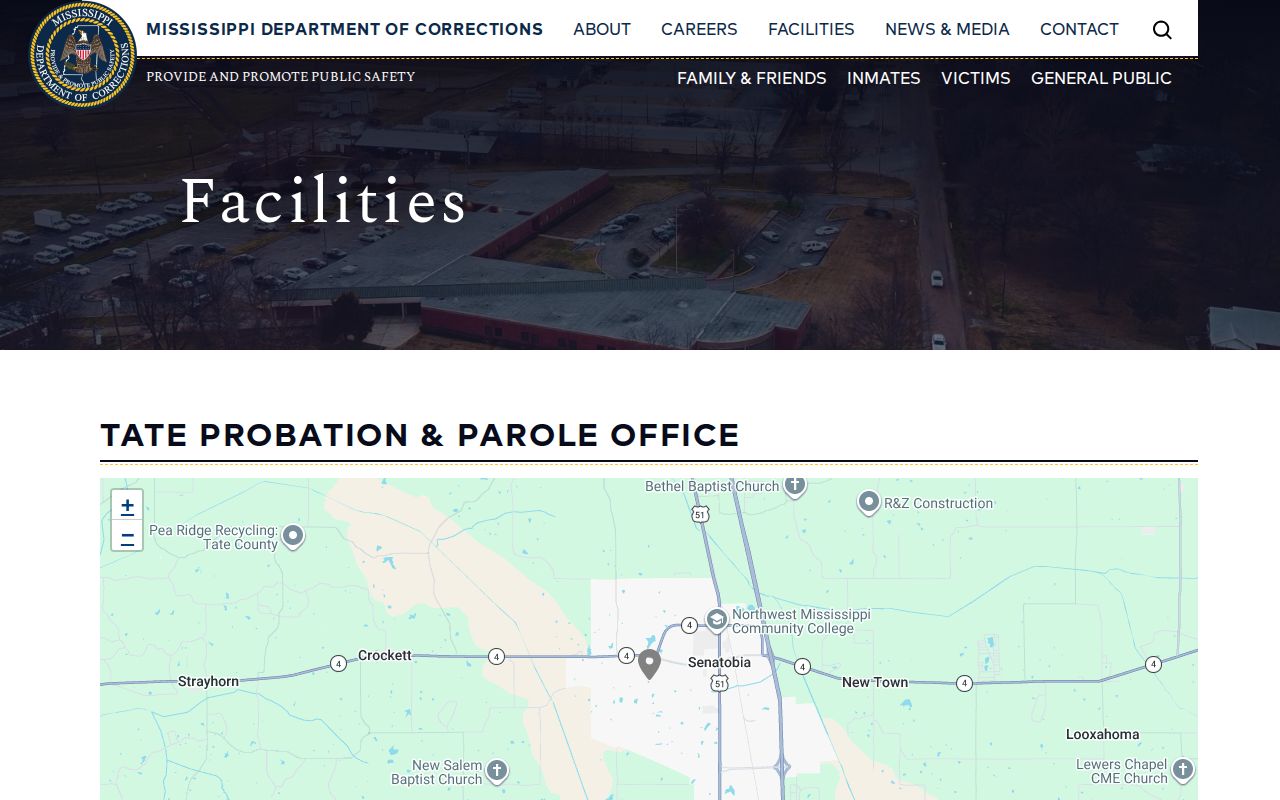
The MDOC page confirms the Senatobia office used when a state parolee record needs local follow-up.
Tate Parole Release Decisions
The Mississippi State Parole Board, not the Tate field office, grants, denies, or revokes parole within its authority. Eligibility under Miss. Code § 47-7-3 depends on the offense, sentence, and date of law. Current administrative rules also identify excluded categories. An eligibility date only means review may be possible. It never guarantees that the Board will grant parole or that a release will happen on that date.
No current official person-by-person hearing calendar, monthly docket, or searchable decision-results page was found in the reviewed state sources. The Board's published numbers are 601-576-3520 and 601-576-3528, with an address at 239 North Lamar Street, Suite 501, Jackson, MS 39201. Call the Board for public hearing or decision information rather than inferring a result from an old schedule or a tentative release date.
A grant can still precede effective release steps and conditions. A denial leaves incarceration in place. A revocation can return a released parolee to custody. Terms such as deferred or rescinded should be used only when the official case record uses them.
Tate Supervision and New Custody
A violation-of-probation charge on the Tate County Jail roster is a current custody clue. It does not, by itself, prove when the person was first released or which supervision status applied. A warrant, revocation order, jail booking, and MDOC status can describe separate stages. Read them in date order and tie them to the same person and case.
An absconder is a supervised person whom the agency reports as having stopped required contact or whose whereabouts are not known under the supervision process. The term should not be applied from a missed public search result. Mississippi SAVIN/VINE may send an abscond supervision notice where the contributing record supports it, but that alert is not a substitute for the warrant, revocation order, or current custodian's record.
- Supervision
- Rules and reporting that continue in the community under a court or corrections agency.
- Flat-time date
- An MDOC record field that must be read in the context of the sentence and current status.
- Revocation
- An official action that may end community placement and return a person to custody.
- Discharge
- The official completion of the applicable sentence or supervision, shown by the responsible agency record.
Tate Release Status Notifications
Mississippi SAVIN/VINE can report custody changes for MDOC and participating county jails. Alerts can cover release, transfer or temporary movement, return to custody, escape, and abscond supervision. Tate County participation must be checked in the live VINELink selector because the state program describes county coverage as participating rather than universal.
The Registration Link can carry an alert registration when a participating county record moves into MDOC or another custody level. That helps distinguish transfer from community release. After any alert, record the event type and agency, then confirm the detail with that agency. A release notice can be timely evidence, but it is not a certified discharge certificate. A transfer notice means custody continued.
The Office of Mississippi SAVIN can be reached at 601-359-5759 during business hours. Its automated/help line is 1-888-9-MSSAVIN, and TTY is 866-847-1298. The current live interface should control which notification channels and confirmation steps are available.
Tate Supervision Release Records
The correct document depends on the claim. A parolee search result supports community supervision. A discharge certificate supports completion of state custody. The court judgment explains probation and sentence terms. A Board order explains a parole decision. The Tate office can help route a public question, but no single public page is guaranteed to display the whole chain.
For an MDOC discharge certificate or time record, use the official MDOC contact route and include the MDOC ID and conviction county. For a probation judgment or revocation order, ask the clerk through the Tate County Circuit Clerk route when that court entered it. For the original county jail release event, use the Tate County Sheriff's Office. The Tate County released inmate record search explains how those documents fit together without collapsing supervision into full discharge.
Corrections should go to the custodian of the faulty entry. An amended court order does not guarantee that the MDOC public page updates at the same instant. Give each office the controlling document and request its established correction process.
Ending Tate Release Supervision
Release from prison and discharge from supervision are separate events. A person may live in Tate County under parole, probation, ERS, intensive supervision, or an interstate compact arrangement while conditions remain active. The public parolee search may support the community placement, but the record that ends the status must come from the court or MDOC. A flat-time date, projected date, or missing web result should not be relabeled as the discharge date.
For parole or ERS, ask MDOC for the document that states the supervision or sentence endpoint. For probation, read the sentencing judgment and any later order that modifies, revokes, or discharges supervision. If the person returned to Tate County Jail, match the new booking to the revocation or violation case rather than assuming the old release was erased. Each event keeps its own date and authority.
The local office is most useful when the public record is dynamic or incomplete. Call with the MDOC number, conviction county, and the exact public field that needs clarification. Staff can follow agency disclosure rules and route a correction request, while the signed order or discharge certificate remains the stronger record for a completed status.